


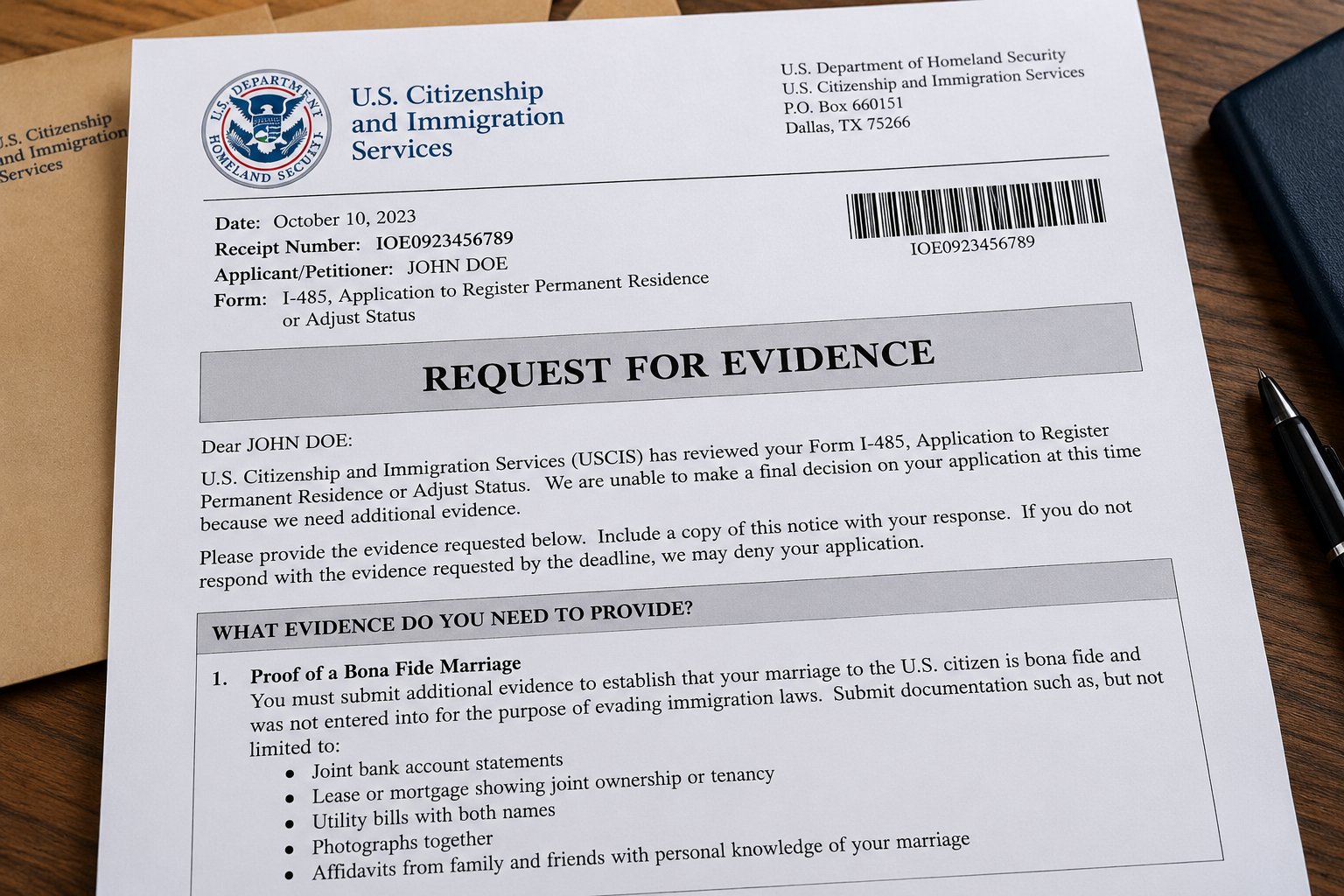
What Is a USCIS Request for Evidence and How Should You Respond?
Naturally, this can be worrying. You may wonder whether something is wrong with your application or whether your chances of approval have been affected.
The important thing to understand is that a Request for Evidence (RFE) does not automatically mean your immigration case has been denied. It means USCIS needs additional evidence before it can make a decision. How you respond, what you submit, and whether you meet the deadline can make a significant difference to your case.
Understanding what the notice means and what steps to take next can help you avoid unnecessary mistakes.
What Is a Request for Evidence?
A Request for Evidence is a formal notice issued by USCIS when the evidence submitted with an application or petition is insufficient to establish eligibility for the immigration benefit being requested.
USCIS may need a missing document, additional proof to support a statement in your application, or clarification about information that has already been provided. The request will generally identify the issues the officer needs you to address and explain what additional evidence is required.
An RFE may arise in different types of immigration cases, including family-based petitions, marriage-based green card applications, employment-based petitions, and applications for certain immigration benefits.
For example, USCIS may request:
- Additional financial records to demonstrate that a sponsor meets the applicable requirements.
- More evidence that a marriage or family relationship is genuine.
- Missing civil documents, such as birth or marriage certificates.
- Additional employment records or proof of qualifications.
- Evidence explaining an aspect of your immigration history.
- A clearer copy of a document or a complete English translation.
The evidence requested depends on your application and the specific concern raised by USCIS. There is no single response that works for every RFE.
Why Does USCIS Send a Request for Evidence?
An RFE can be issued for several reasons. Sometimes, an applicant simply leaves out a required document. In other cases, the documents submitted do not sufficiently establish a particular eligibility requirement.
For instance, someone applying for a marriage-based green card may submit a marriage certificate but provide little evidence that the couple shares a genuine marital relationship. USCIS may request additional documents showing their shared residence, finances, or other aspects of their life together.
In a family-based immigration case, the agency may need more financial information from a sponsor. An employment-based petition may require further documentation of the applicant’s qualifications or the position being offered.
An RFE can also arise when documents are unclear, information appears inconsistent, or the evidence does not adequately address a requirement under immigration law.
Receiving an RFE does not necessarily mean you did anything wrong. However, you should understand exactly what USCIS is questioning rather than treating the notice as a routine request for paperwork.
Does a Request for Evidence Mean Your Case Will Be Denied?
No. An RFE allows you to provide additional evidence before USCIS makes a decision. A complete and relevant response may help establish that you qualify for the benefit you requested.
However, the request should not be ignored or treated lightly. If you fail to provide the requested evidence, submit an inadequate response, or miss the deadline, USCIS may make a decision based on the existing record. Depending on the circumstances, this could result in a denial.
It is also important to recognize that submitting more documents does not automatically guarantee approval. The evidence must address the concerns raised and establish eligibility under the applicable immigration rules.
Your goal should be to understand what the officer needs to determine and provide a clear, well-supported response.
What Should You Do After Receiving a Request for Evidence?
1. Read the Entire Notice Carefully
Start by reading the RFE from beginning to end. Pay attention to the specific issues USCIS has identified, the evidence requested, the submission instructions, and the response deadline.
Do not focus only on the first page or assume the request concerns a document you can easily replace. Some notices identify several separate concerns, and each may require a different type of evidence.
If the notice refers to a particular immigration requirement, make sure you understand what USCIS needs you to establish. Addressing only part of the request may leave important questions unanswered.
2. Identify Exactly What Is Missing
Once you understand the notice, compare the requested evidence with the documents you originally submitted.
Create a list of each item USCIS wants and identify what you already have, what needs to be obtained, and whether an alternative form of evidence may be appropriate.
For example, if USCIS requests proof of a shared residence, you might review available lease agreements, utility bills, insurance documents, or other records showing that you and your spouse live together. If the request concerns financial sponsorship, you may need to gather additional tax records, income documentation, or other relevant financial evidence.
If a requested document is unavailable, do not simply ignore that part of the notice. Determine whether another document can establish the same fact and whether an explanation is necessary.
3. Gather Relevant and Reliable Evidence
The strongest response is not necessarily the one with the most pages. It is the one that directly addresses the issues USCIS raised.
Gather authentic documents that support your eligibility and make sure they are clear and complete. Check that names, dates, addresses, and other important details are consistent across the records.
If you are submitting documents in a language other than English, USCIS generally requires a complete English translation accompanied by the translator’s certification that the translation is complete and accurate and that the translator is competent to translate into English.
Do not alter documents, create evidence that does not reflect the facts, or submit misleading information. False or fabricated evidence can create serious immigration consequences beyond the application currently being reviewed.
4. Prepare a Clear, Organized Response
Your response should make it easy for the reviewing officer to see how each document addresses the request.
A useful approach is to arrange your response according to the issues listed in the RFE. You can include a cover letter or response statement identifying each concern and explaining which supporting documents address it.
For example, if USCIS requests additional evidence of a genuine marriage, you might organize the response into sections covering shared residence, joint finances, insurance, and other relevant evidence. If the request concerns financial eligibility, arrange the supporting records around the specific financial requirements identified in the notice.
Avoid sending a large collection of unrelated documents without explaining their relevance. A well-organized submission can help the officer review the evidence more efficiently.
5. Respond Before the Deadline
The deadline is one of the most important parts of an RFE. Your notice will state when USCIS must receive your response, and you should follow the specific instructions provided.
Do not wait until the final day to begin gathering documents. Some records take time to obtain, especially if they must come from an employer, financial institution, government agency, or another person.
Allow time to review the documents, prepare any explanations, and confirm that the response is complete. Also, check the permitted submission method and whether the instructions require the original notice, a copy, or a particular cover sheet.
If you need more time, do not assume USCIS will grant an extension. RFE deadlines are generally fixed, and extensions are not ordinarily available. If you are unsure how the deadline applies to your case, seek legal guidance promptly.
6. Keep a Copy of Everything You Submit
Before sending your response, retain a complete copy of the RFE, your written response, all supporting documents, and any proof of delivery or electronic submission confirmation.
These records can help you confirm what was submitted and when. They may also be useful if USCIS later asks questions about the evidence or you need to consult an attorney about the case.
After submission, monitor your case status and keep any subsequent notices you receive.
What If You Already Submitted the Requested Document?
Sometimes, an applicant receives an RFE for a document they believe was included in the original filing. This can be frustrating, especially if you spent considerable time preparing the application.
First, review the RFE carefully and check your copy of the original submission. Confirm that the document was included, that it was legible, and that it actually addressed the requirement USCIS identified.
You may need to submit the document again, provide a clearer version, or explain how the evidence addresses the concern. However, simply stating that you already submitted it may not be enough.
The important thing is to respond to the notice rather than assume USCIS will locate the original document or correct the issue without further action.
Can You Respond to an RFE Online?
Depending on your case type and the instructions provided, you may be able to respond through your USCIS online account. Other cases may require you to submit the response using the specified mailing address or another method described in the notice.
Do not assume that every RFE can be answered online. Follow the instructions in your specific notice, including any requirements regarding document format, submission method, and delivery.
If you submit electronically, keep the confirmation for your records. If you submit by mail, use a reliable delivery method and retain the tracking information.
What Happens After You Respond?
After USCIS receives your response, the agency will continue reviewing your application or petition. The next step may be an approval, a denial, or another action depending on the circumstances and whether the evidence establishes eligibility.
Processing times vary. Receiving confirmation that your response was delivered does not mean your application has been approved, and there may be a period of waiting before the next decision.
If USCIS denies the application despite your response, the options available to you will depend on the type of case, the reasons for the denial, and the applicable legal procedures. Some decisions may offer an avenue for further review, while others may require a different approach. Review any denial notice promptly because the deadlines for taking further action can be strict.
Do You Need a Lawyer to Respond to an RFE?
Not every RFE requires an attorney. If the request is straightforward and asks for a clearly identified missing document, you may be able to prepare the response yourself.
However, legal assistance may be particularly useful when the request questions whether you qualify for an immigration benefit, identifies inconsistencies in your records, concerns your immigration history, or involves complicated financial, employment, or family evidence.
An immigration lawyer can review the notice, explain the legal issues involved, help identify appropriate supporting evidence, and prepare a response that addresses the concerns raised. Legal guidance can also help you avoid submitting irrelevant documents or overlooking a problem that requires more than additional paperwork.
How Mokolo Law Firm Can Help
Receiving a Request for Evidence can be stressful, particularly when you do not understand why USCIS needs more information or what the request means for your application.
Mokolo Law Firm can help you understand your RFE and determine how to respond. Our approach involves reviewing the notice, identifying the issues USCIS has raised, examining the available documents, and helping you understand what additional evidence may be needed.
Whether your case involves a marriage-based green card, a family petition, or another immigration benefit, the response should be tailored to the specific request and the facts of your case.
If you have received an RFE, do not wait until the deadline is close before seeking help. Contact Mokolo Law Firm to discuss your notice, understand your options, and determine the appropriate next steps for your situation.
Final Thoughts on What Is a USCIS Request for Evidence and How Should You Respond?
A Request for Evidence can feel like a setback, but it is not automatically a denial. It is an opportunity to address the questions USCIS has raised before a decision is made.
The key is to respond carefully. Understand what the notice requires, gather reliable evidence, organize your submission, and meet the deadline. If a requested document is unavailable or the notice raises a complicated legal issue, do not guess at the answer.
Your response can be an important part of your immigration case. If you are unsure what USCIS is asking for or how to address its concerns, Mokolo Law Firm can help you understand the request and approach the next step with greater confidence.
Latest Posts
 by Mokolo Law
What Is a USCIS Request for Evidence and How Should You Respond?
You have submitted an immigration application and are waiting for a decision. Then, instead of receiving an approval notice, you receive a letter from U.S....
by Mokolo LawCan You Get a Green Card Through Marriage After a Visa Overstay?
You overstayed your visa. Now you are married to a U.S. citizen, and you want to know whether you can still get a green card. The good news is that a visa...