


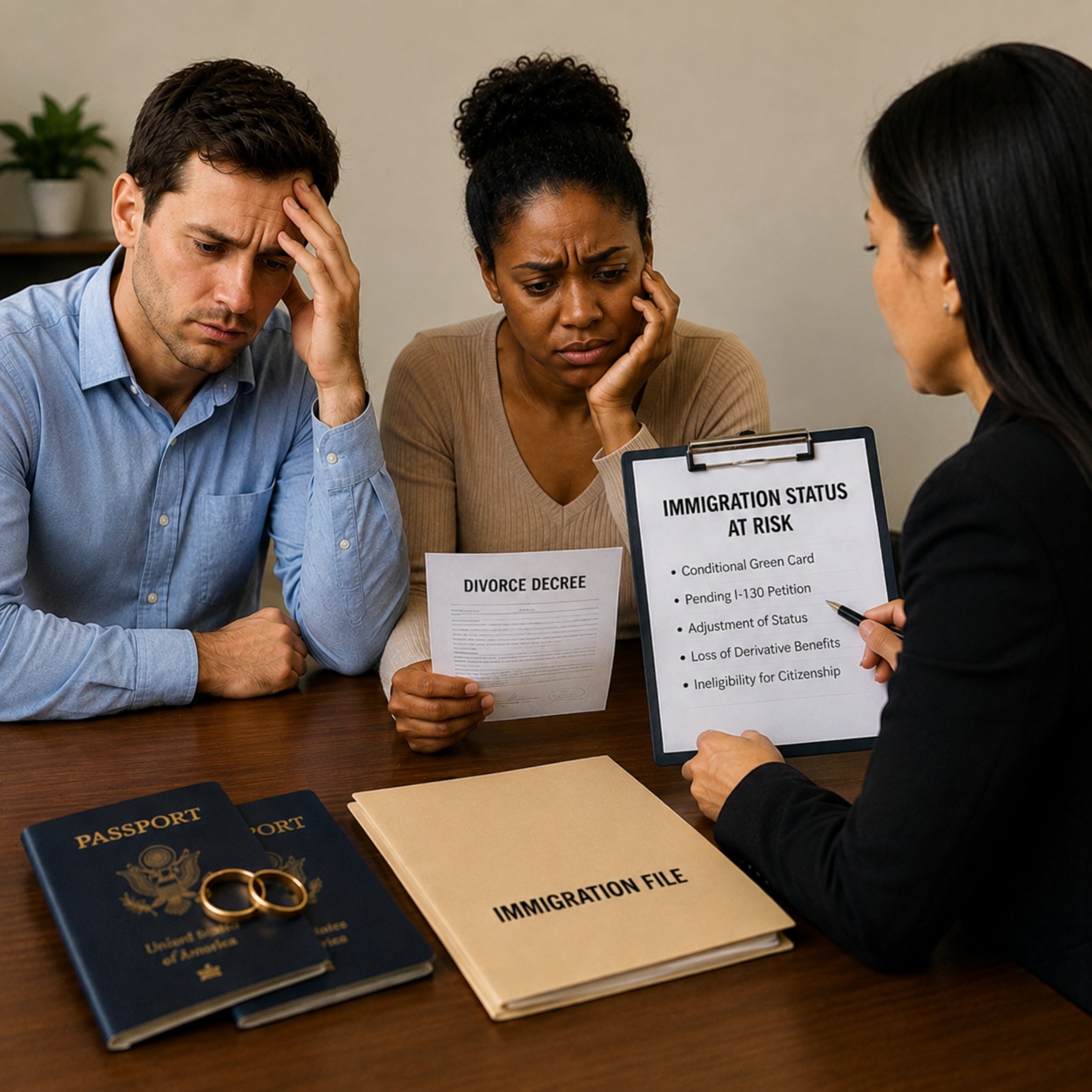
How Divorce Affects Your Immigration Status or Pending Green Card Application
Divorce is never easy. When your ability to remain in the United States is tied to your marriage, the emotional strain can quickly become a legal concern. A pending immigration petition, conditional green card, or dependent visa may all be affected when a marriage ends, but the consequences depend on where you are in the immigration process and the type of status you currently hold.
The good news is that divorce does not automatically mean you will lose your immigration status. In many situations, options remain available, especially if you understand your rights and take action before making major legal decisions.
If you’re considering separation or divorce, it’s important to understand how family law and immigration law intersect before taking the next step. The following overview is based on the source material provided.
Divorce vs. Separation: Why the Difference Matters
Many people use the terms divorce and separation interchangeably, but they are not the same under the law.
A divorce legally ends a marriage. Once the court enters a final divorce decree, the marital relationship is terminated.
A separation, on the other hand, generally means spouses are living apart while remaining legally married. Depending on the state, legal separation may have different legal consequences, and in some jurisdictions it may eventually lead to divorce.
For immigration purposes, U.S. Citizenship and Immigration Services (USCIS) and the Board of Immigration Appeals evaluate the legal effect of your marital status under applicable state law. Because immigration consequences can vary, understanding the legal status of your relationship before filing for divorce is critical.
Does Divorce Automatically Affect Your Immigration Status?
Not always.
Whether divorce changes your immigration status depends on several factors, including:
- Your current immigration status
- Whether your green card is conditional or permanent
- Whether you have a pending immigration application
- Your spouse’s immigration status
- When the divorce occurs during the immigration process
Two individuals going through similar divorces may experience very different immigration outcomes depending on these circumstances.
If You Already Have a Permanent Green Card
If you already hold a 10-year permanent green card, divorce generally does not cancel your lawful permanent resident status.
However, divorce may affect your path to U.S. citizenship.
Many permanent residents who remain married to a U.S. citizen may qualify to apply for naturalization after three years. If the marriage ends before naturalization, that accelerated timeline may no longer apply, and you may instead need to satisfy the standard five-year residency requirement.
When you later apply for citizenship, USCIS may also review the circumstances surrounding your marriage to determine whether it was entered into in good faith. Maintaining documentation showing your marriage was genuine can become important if questions arise during the naturalization process.
If You Have a Conditional Green Card
The situation is different for individuals who received a conditional green card through a marriage that was less than two years old when permanent residence was granted.
Conditional permanent residence is valid for two years. Ordinarily, both spouses file Form I-751, Petition to Remove Conditions on Residence, together before the card expires.
If divorce occurs before that filing, the process becomes more complicated—but not necessarily impossible.
The source explains that applicants may still seek to remove the conditions by requesting a waiver of the joint filing requirement. To qualify, they must demonstrate that the marriage was entered into in good faith rather than for immigration purposes.
Helpful evidence may include:
- Joint bank account records
- Shared leases or mortgage documents
- Insurance policies
- Photographs
- Credit accounts
- Other records showing the couple built a genuine married life together
Although divorce increases the scrutiny applied to these cases, it does not automatically prevent an applicant from becoming a permanent resident.
Divorce Before Your I-130 Is Approved
Timing matters.
If your spouse filed Form I-130, Petition for Alien Relative, and the marriage ends before USCIS approves that petition, the immigration process can stop immediately.
According to the source, once the marriage legally ends, the basis for the family-based petition generally no longer exists. USCIS may revoke or deny the petition because eligibility depended on the marital relationship.
If you do not have another lawful basis for remaining in the United States, you may need to explore other immigration options that are independent of your former spouse.
Divorce While Adjustment of Status Is Pending
A pending adjustment of status application can also be affected by divorce.
If you are applying for permanent residence as the spouse of a U.S. citizen, a divorce while the adjustment application is pending may prevent approval because the underlying marriage petition no longer supports the application.
For spouses of lawful permanent residents, the legal analysis may differ depending on the circumstances and the stage of the immigration process. As the source explains, the timing of the divorce and changes in the sponsoring spouse’s immigration status may significantly influence the available options.
Because these cases often involve complex procedural issues, obtaining legal advice before finalizing a divorce can be one of the most important decisions an immigrant spouse makes.
Conditional vs. Permanent Green Cards After Divorce
The impact of divorce often depends on the type of green card you hold.
If you have a conditional green card, ending the marriage before filing Form I-751, Petition to Remove Conditions on Residence, creates additional legal requirements. Instead of filing a joint petition with your spouse, you may request a waiver that allows you to file independently. To succeed, you’ll need to demonstrate that the marriage was entered into in good faith, even though it ultimately ended in divorce.
Evidence commonly used to support this type of filing includes joint financial records, lease or mortgage agreements, insurance policies, photographs, correspondence, birth certificates of children, and affidavits from people familiar with your relationship. The stronger the documentation, the easier it becomes to establish that the marriage was genuine.
If you already have a 10-year permanent green card, the situation is generally much different. Divorce alone does not cancel your lawful permanent resident status. However, if you planned to apply for U.S. citizenship under the shorter three-year residency rule available to certain spouses of U.S. citizens, you may instead need to satisfy the standard five-year residency requirement.
Protection for Immigrants Experiencing Abuse
Some immigrants remain in abusive marriages because they fear losing their immigration status. The law recognizes this concern and provides important protections.
Under the Violence Against Women Act (VAWA), eligible spouses of U.S. citizens or lawful permanent residents may be able to file a self-petition without relying on the abusive spouse’s cooperation. The process is confidential, and the abusive spouse does not need to participate or even be informed of the filing.
According to the source, applicants may qualify if they entered the marriage in good faith, experienced battery or extreme cruelty, meet certain moral character requirements, and satisfy other eligibility criteria. Supporting evidence may include police reports, medical records, protective orders, counseling records, witness statements, and personal declarations describing the abuse.
Steps to Take Before Finalizing a Divorce
If your immigration status depends on your marriage, timing can be critical.
Before taking legal action, consider these important steps:
- Speak with an experienced immigration attorney before the divorce is finalized.
- Gather documents showing your marriage was genuine, including financial records, photographs, correspondence, and other shared records.
- If you have a conditional green card approaching expiration, do not miss the deadline to file Form I-751.
- If you are experiencing abuse, seek legal protection and explore immigration options that may be available under federal law.
In many situations, obtaining legal advice before finalizing a divorce can preserve immigration options that may no longer exist after the divorce becomes final.
Protect Your Immigration Future with Mokolo Law Firm
A divorce can change your family life, but it should not leave you uncertain about your future in the United States. Immigration laws are complex, and the timing of a divorce, the type of immigration benefit you have, and the stage of your case can all affect your legal options.
At Mokolo Law Firm, we understand that immigration and family law often overlap in ways that create difficult legal and personal decisions. Whether you’re dealing with a pending marriage-based petition, a conditional green card, an adjustment of status application, or concerns about maintaining lawful status after divorce, our legal team is prepared to help you understand your rights and develop a strategy tailored to your situation.
We assist clients with marriage-based immigration matters, waivers, USCIS filings, removal of conditions on residence, and other complex immigration issues arising from separation or divorce.
If your marriage is ending and you’re concerned about how it may affect your immigration status, don’t wait until a missed deadline or denied application limits your options. Contact Mokolo Law Firm today to schedule a confidential consultation. We’ll evaluate your case, explain your legal rights, and help you pursue the strongest path forward.
Final Thoughts on How Divorce Affects Your Immigration Status or Pending Green Card Application
The end of a marriage does not always mean the end of your immigration journey. While divorce can affect certain immigration benefits, the law also provides protections for many individuals, including those with permanent resident status, conditional residents who can demonstrate a good-faith marriage, and survivors of domestic abuse.
The most important step is understanding how your specific immigration status may be affected before major legal decisions are made. Acting early can preserve valuable rights, prevent avoidable delays, and open immigration pathways that might otherwise be lost.
If your immigration status is connected to your marriage, don’t rely on assumptions or informal advice. A careful legal review of your situation can make a significant difference in protecting both your future and your ability to remain in the United States.
Latest Posts
 by Mokolo Law
K-1 Fiancé Visa vs. CR-1 Spouse Visa: Which Is Better for You?
Planning a life together in the United States is exciting, but choosing the right immigration route can be complicated. For couples where one partner is a...
by Mokolo LawIs Mediation Required in a Texas Divorce, and What Happens If One Spouse Refuses?
Divorce does not always have to end in a courtroom battle. In Texas, mediation often helps spouses resolve disagreements about property, finances,...